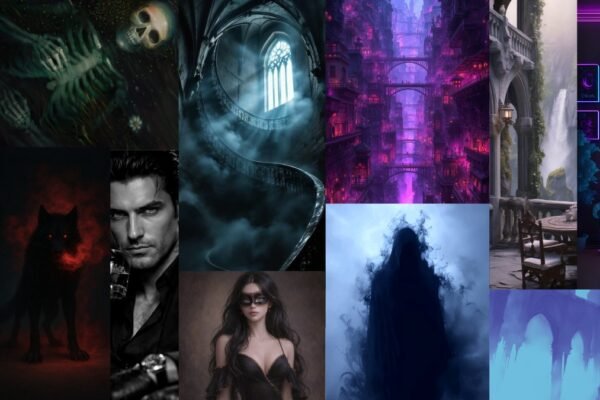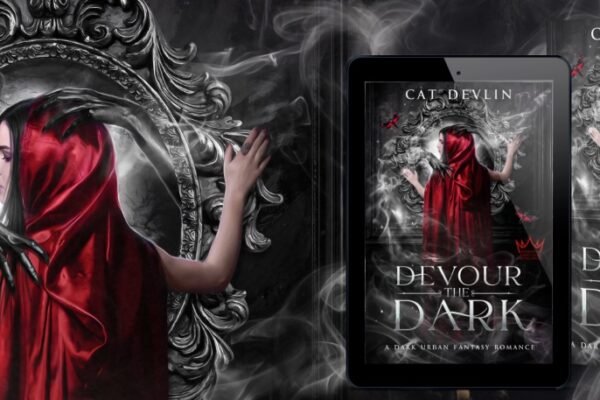

I’ve always loved gothic literature, but if I truly had to pinpoint where my love affair with gothic + fantasy + romance started, it was probably way back with Peter S. Beagle’s The Last Unicorn. I was three when I saw that movie in the theater, and it painted a deep love of fairytales, fantasy, and heartache in broad strokes across my heart. The Phantom of the Opera was another early influence, as was Shakespeare, Bram Stoker, Edgar Allen Poe and The Brothers Grimm. As I developed my craft, I started to see a picture emerge of the kinds of stories I wanted to write: tales of flawed people who would face any shadow for love.
The Last Unicorn is classified as a fantasy novel, but I’d argue many of its ideas echo distinctly gothic themes. The central theme, for example, is one of hubris: as the noble Unicorn realizes that she’s lost touch with the world, she also discovers she may be the last of her kind. She does not believe this, so she embarks on a quest to prove it’s not true, and in the process grapples with what it means to lose her connection to her divine identity. This asks the reader an important question: Who are we really if we have nothing to believe in, and no one believes in us?
When the Unicorn becomes the Lady Almalthea, her transformation from supernatural beast to woman forces her to confront the difference between myth vs. reality, as well as the divine vs. mundane. She’s terrified to lose the last parts of her supernatural self, but she also desires to experience what no unicorn has ever experienced: love. Unicorns are divine creatures, incapable of mortal love, and to become human forever taints their purity. Yet it’s only when the Unicorn is transformed into a mortal that she is truly seen – both as an individual woman and as a divine creature.
King Haggard is another gothic echo; besides the dark kingdom that embodies his name, his entire character arc explores the relationship between beauty, selfish love, suffering and the monstrous. There’s a sense that it’s not a lack of love that drives him, but a spiritual hole in his soul. He doesn’t value companionship, and he doesn’t even truly want beautiful things. He wants meaning, a thing he’s only able to satisfy by hunting the divine unicorn. Brilliantly, this echoes the Unicorn’s quest as well. The act of driving the unicorns into the sea becomes a metaphor for Haggard’s attempt to fill his soul with the divinity mortal relationships can’t provide, and the Unicorn seeks others like herself to prove she still has value in the world.
Yet the King’s mad desire also poisons everything around him. The castle becomes a dark, lonely prison. The land is lifeless, and the supernatural “Red Bull” who lives in the bowels of the castle reminds the reader that it’s a cursed place that manifests into a literal demonic creature. Haggard’s kingdom embodies the hallmark of gothic literature – the setting is a reflection of the characters’ inner struggle, and as Haggard’s focus sharpens on his obsession, his kingdom falls deeper into into ruin.
Though the Red Bull is the monster in this novel (and a comparison could be drawn to religious themes of demon/evil), I think he’s really intended to manifest an aspect of Haggard himself. He lives in the castle, terrorizing the countryside, and keeps the unicorns trapped for Haggard’s pleasure. The Red Bull becomes the embodiment of Haggard’s evil – a supernatural personification of his worst qualities. When the Unicorn ultimately defeats the Bull by driving him into the sea, it’s not so much a victory as a transformation. Haggard accepting his own darkness, however tragic, is ultimately what allows him to let go. His son’s death (and restoration by the Unicorn) symbolizes the death of the past and hope for a better future.
Again, there are strong religious themes underscoring all of this as well – Haggard’s death could be seen as the death of a selfish and temperamental Old Testament God, while Lir’s death and resurrection parallels the death of Jesus, and serves to initiate a new, more forgiving world for those he rules over. The Unicorn, however, remains a constant – always pure and bright, she never waivers in her belief even as she seeks her own answers about her meaning. Instead, she comes to understand humankind better, and while she cannot remain with them, there is a sense that she is now more connected to them. One might even go so far as to say that together, Haggard, Lir and the Unicorn represent the divine Trinity – the Father, Son and Holy Ghost. That juxtaposition of the spiritual with the fantastical is another hallmark of gothic fiction.
All that said, Beagle’s story also broke my heart, and that’s why it influences my writing today. Woven throughout this dark tale of spiritual redemption and self-identity is also a tale of romantic love, and if you look at it just through a romantic lens, I desperately wanted the Unicorn to stay human and fall in love. The heartbreak I felt when she didn’t has stayed with me because it felt like a betrayal. He gave his life for her, but she chose immortality and her true self over him. Was she wrong to do so?
In fantasy romance, we want powerful characters, but we also want epic love. I think in this instance, I craved the fantasy of the divine fall from grace for love, because love is ultimately the most important act, and what is all the hard struggle for if we don’t find love at the end? That divine fall is inherently Gothic because it’s a transgression against order – it’s the chaos of desire winning against duty or fate.
In my opinion, this is where Gothic Fantasy Romance shines, and why my stories will always lean Gothic. Gothic Fantasy Romance (and my writing) explores the connection between extreme emotions – such as desire and fear – and wonderful, terrifying possibility. Dark Fantasy focuses on morally questionable choices in an imaginary world; Gothic Fantasy explores those same choices as intentional transgressions in the pursuit of desire, autonomy and transformation. Gothic fantasy often evokes dread and beauty in equal measure – dark passages, ornate haunted houses, crumbling castles, vampires or monsters, death, and foggy moors, as examples. But these aesthetics are simply meant to signal to the reader that the boundary between the natural world and the supernatural is thin – and the opportunity to discover what we don’t know – and the risks of doing so – is a temptation we simply can’t resist.